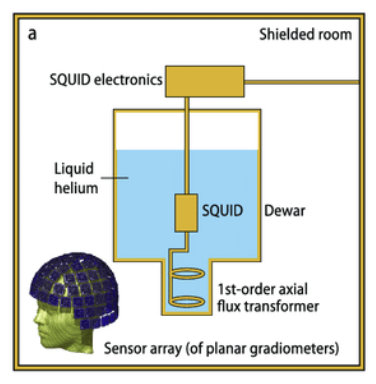
Magnetoencephalography (MEG) is a passive sensing technique that measures electrophysiological brain activity by reconstructing primary current sources from magnetic field recordings on the scalp.
Theory
We denote MEG measurement recordings to be a:
- a single component of the magnetic field , measured in tesla , for a magnetometer readout
- the spatial derivative of a component of , , e.g., for the simplest gradiometer readout, where and are two nearby sensor locations.
Analogous to EEG, we might use the raw measurement recordings directly however, it is typical to perform source reconstruction as outlined below.
We make explicit the dependence of measurements at sensor positions , on the primary current density , measured in amperes per squared meter , due to neuronal activity:
| where | |
|---|---|
| Hilbert space of functions representing admissible current densities | |
| Hilbert space of functions representing admissible measurement recordings | |
| noise component of the signal | |
| time, measured in seconds | |
| operator that models how gives rise to in the absence of noise. |
We can define the action of on more precisely as:
| where | |
|---|---|
| magnetic field that depends implicitly on | |
| position vector in three-dimensional space, typically expressed as and measured in meters | |
| Hilbert space of functions that represents all admissible magnetic fields | |
| operator that extracts at sensor positions and outputs measurements according to the sensor type (e.g. magnetometer, gradiometer) |
From the quasi-static approximations of Maxwell’s equations, we obtain the system of equations:
| where | |
|---|---|
| electrical conductivity, measured in siemens per meter | |
| electric potential, measured in volts | |
| permeability of free space, measured in henry per meter |
Magnetoencephalography attempts to solve the inverse of equation , i.e., determining from . Since is unlikely to lie exactly within the range of due to the presence of noise and modeling inaccuracies, the problem is reformulated as finding the optimal whose response best matches . This reformulation involves minimizing the distance between and , defined using a suitable metric and encoded as an objective function, or in the sense of the calculus of variations, a functional :
A common choice for is the least-squares misfit:
where is the norm squared in the space of vectors indexed by (discrete) and (continuous, say).
Conductivity reconstruction
We might also be able to reconstruct for conductivity in the same manner that we reconstruct for the primary current sources. Compared to source reconstruction, the proposed method sets , simplifying the system of equations, and reconstructs for . It is hypothesized that will vary locally in time according to primary current sources, and that the newly formed problem of scalar field reconstruction will have a smaller solution space compared to the vector field reconstruction of , easing the ill-posedeness of the inverse problem.