Below we will perform a calculation to assess the extent of sodium ion concentration change during an action potential.
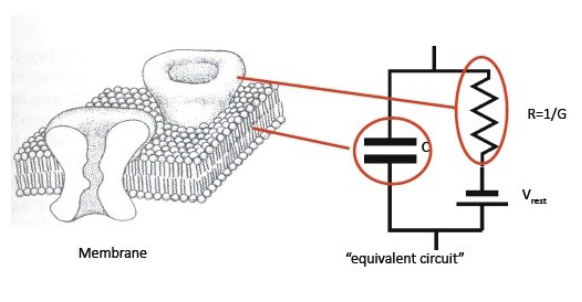
We can model biological membranes as a simple equivalent circuit with a capacitor and resistor in parallel:
- the capacitor represents the lipid bilayer, responsible for storing charge across the plasma membrane,
- the resistor represents the combined ion permeation pathways (e.g. ion channels and transporters) in the membrane.
Change in the entire neuron
Membrane charge transfer
The charge separated across the biological membrane is given by
where:
- is the specific membrane capacitance
- is the change in membrane potential which occurs during an action potential
Since each ion carries an elementary charge of , the number of ions per is:
Total ion entry over the neuron
Assuming a roughly spherical neuron with a diameter of , the surface area is:
Thus, the total number of ions entering during the spike is:
Relative change in concentration
The cytoplasmic volume of the neuron is approximately:
With a resting intracellular concentration of , the total number of ions is roughly:
The fractional increase is then:
This small percentage supports the assumption that bulk intracellular ionic concentrations remain essentially constant during an action potential.
Change in a single spine
Resting sodium content
A typical pyramidal cell spine head with a volume of is estimated to contain roughly
at a resting concentration of (Eberhardt et al., 2022).
Ion entry during synaptic event
During an excitatory postsynaptic potential (EPSP), suppose a synaptic current of 23 pA flows for 12 ms (Cornejo et al., 2022; Acker et al., 2016). The total charge delivered is:
Converting this charge into the number of ions:
Relative change in the spine
The ratio of the ions entering during the synaptic event to the resting content is:
This implies that the local sodium concentration in the spine could, in principle, increase from 10 mM to approximately:
a dramatic increase compared to the whole neuron.